2026-06-08
Calming techniques for hyperactivity in kids with ADHD and autism
How to calm hyperactivity, sensory overload, big feelings, and hard transitions in kids with ADHD, autism, AuDHD traits, or no diagnosis yet.
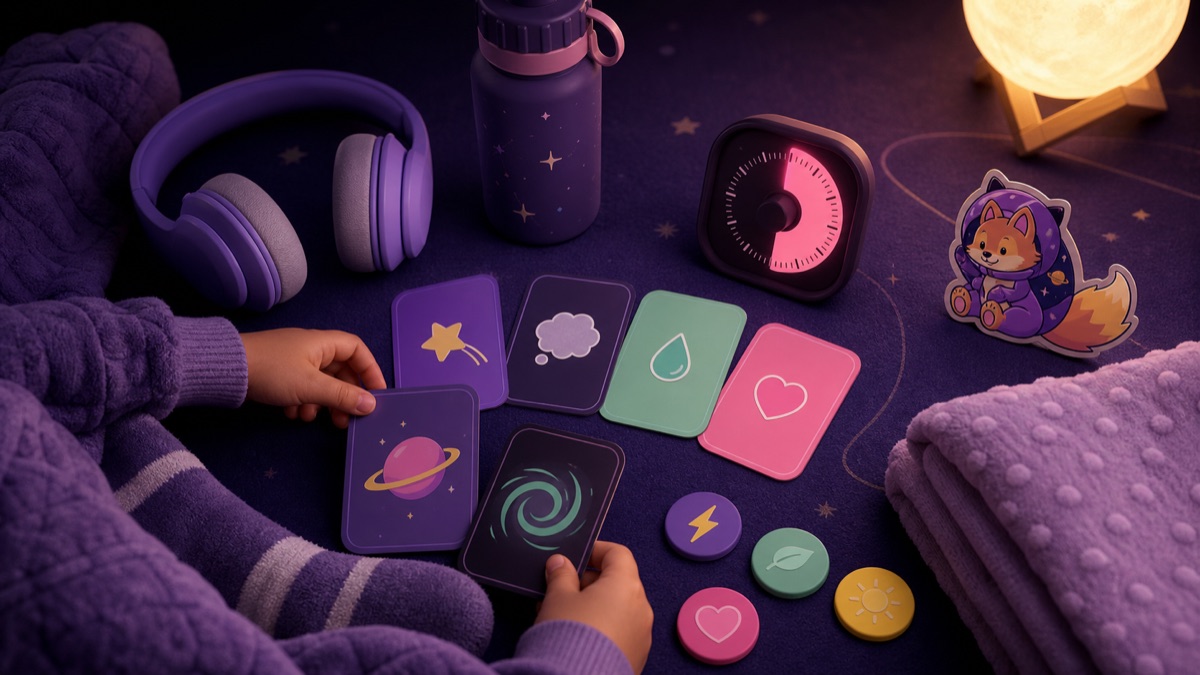
Calming strategies for kids work better when they match what is actually happening in the child's body.
Sometimes the problem is noise. Sometimes it is hunger, heat, scratchy clothes, a hard transition, too many instructions, or the feeling of being watched while already overwhelmed.
For children with ADHD, autism, AuDHD traits, sensory sensitivity, anxiety, or no diagnosis yet, "calm down" is often too big a job. The useful question is smaller:
What can we remove, reduce, or make easier right now?
Quick answer: how to calm a hyperactive child
If you are trying to figure out how to calm a hyperactive child, start with the body before asking for quiet. Many ADHD calming strategies work better when the child gets a safe way to use energy first.
Try this order:
- Reduce noise, light, crowding, or extra talking.
- Give the body a safe job: wall push, chair push-up, carrying laundry, animal walk, or jumping in one safe spot.
- Offer water, pressure, or a quiet place.
- Shrink the next task to one visible step.
Calming techniques for hyperactivity help the body move from unsafe or chaotic energy into something safer and easier to guide.
This guide is for everyday moments of overload at home, school, or in public. If your child is hurting themselves or others, losing control often, or you feel unsafe, ask your pediatrician, GP, therapist, or local emergency service for help.
Start with the body and the room
Before giving advice, check the basics.
A child who looks defiant may be overloaded, hungry, tired, hot, cold, itchy, thirsty, or stuck in a transition that their brain cannot organize yet.
Try scanning the environment:
- Is the room loud?
- Are the lights harsh?
- Is clothing bothering them?
- Is there a smell, crowd, or screen noise?
- Has the child eaten or had water?
- Did the plan change quickly?
- Are too many people talking?
You do not need to solve every possible cause. Pick the loudest one.
If the room is too bright, dim the light. If the child is surrounded, create space. If three adults are talking, let one person speak. If the task has too many steps, shrink it to one.
Changing the environment first can help because it asks less from a child who may already be past their limit.
Use fewer words
When a child is overloaded, language can become another demand.
Short phrases usually work better than explanations:
- "You're safe."
- "I am here."
- "Less talking."
- "Water or blanket?"
- "Quiet corner or hallway?"
- "One minute, then we check."
Avoid asking for a full explanation during the hardest part. Many kids cannot explain what happened while it is happening.
You can still set limits. Keep them short:
"I won't let you hit. I will move the chair."
"Throwing hurts people. Pillow is okay."
"We can pause. We are not leaving the building yet."
The goal is to reduce input while keeping everyone safe.
Offer one calming choice
Too many options can make overload worse.
Offer one clear pair:
- headphones or quiet room
- water or snack
- wall push or blanket
- sit near me or sit alone
- timer or no timer
- lights low or door open
If choices create more stress, choose the lowest-demand option and narrate it simply:
"I am turning the sound down."
"I am moving the backpack away."
"I am sitting beside you."
A calming strategy does not have to look impressive. It only needs to lower the amount the child has to process.
Match the strategy to the kind of overload
Different kids calm in different ways. The same child may need different support on different days.
Try thinking in categories.
Too much sound or light
Use:
- headphones
- dim lights
- sunglasses or cap
- quiet corner
- fewer voices
- a short break outside the room
Say:
"Too loud. We are making it quieter."
Too much body energy
Use:
- wall pushes
- chair push-ups
- jumping in one safe spot
- carrying a laundry basket
- animal walks
- a short walk around the block
Say:
"Your body has extra electricity. Let's move it safely."
Calming techniques for hyperactivity and too much body energy
When parents search for calming techniques for hyperactivity, they are often looking for a way to help a child whose body cannot settle yet. Sitting still may be too hard at first.
If you are trying to calm hyperactivity, start by giving the body a safe job before asking for quiet:
- push hands against a wall for ten seconds
- carry a laundry basket to another room
- jump on one spot, then sit for a sip of water
- walk to the door and back
- squeeze a pillow or blanket
- do chair push-ups
- crawl like a bear to the next card
Then lower the demand:
- Move.
- Drink.
- Sit near the next step.
For many kids, calming down starts with giving the body a safe job. After that, quiet strategies have a better chance.
Too much feeling
Use:
- pressure hug, if the child likes it
- blanket burrito
- hand on chest
- drawing the feeling
- naming one body signal
- sitting together without questions
Say:
"Big feeling. We can make the room smaller."
Too many steps
Use:
- one card
- one object
- one first action
- a two-minute timer
- a "do less" version of the task
Say:
"Only this step."
"Touch the toothbrush."
"Put one sock near your foot."
For some kids, regulation starts when the task becomes small enough to approach.
Build a small reset menu
Make the reset menu before the next hard moment.
Pick four or five options your child already tolerates:
- headphones
- water
- blanket
- wall push
- quiet corner
- soft toy
- music
- body doubling timer
- one tiny mission
Put them somewhere visible. A reset menu can be a card, a basket, a note on the fridge, or a screen in an app.
Use simple labels or icons. During overload, the child should not have to read a paragraph or answer a long question.
Try this format:
Reset menu
- Quiet.
- Water.
- Pressure.
- Move.
- Stay with me.
The menu does not need to be perfect. It needs to be easy to find.
During a meltdown, lower demands
A meltdown is not the moment for teaching a lesson.
Focus on safety, space, and less input:
- move breakable objects
- reduce noise and light
- give physical space
- keep your voice low
- use very short sentences
- avoid debating what happened
- avoid extra touch unless the child wants it
Some children want closeness. Some need distance. Some want pressure. Some cannot handle touch at all. Use what you know about your child, and update the plan when you learn more.
If your child has a support plan from an occupational therapist, psychologist, school team, or doctor, follow that plan.
After the storm, repair gently
The conversation after overload should be short.
Wait until the child is regulated enough to eat, drink, look around, or play again. Then use a small review:
- What was too much?
- What helped a little?
- What should we try first next time?
You can also skip the conversation and update the environment quietly.
If the supermarket was too loud, pack headphones next time. If homework crashed after three instructions, write one step on a card. If bedtime fell apart after screen time, add a transition warning earlier.
Repair means one useful change for next time.
A calming plan to try this week
Choose one predictable hard moment:
- getting dressed
- leaving the house
- homework
- bath time
- bedtime
- the supermarket
- the end of screen time
Then write a tiny plan.
When everything is too much
- Make the room quieter.
- Use fewer words.
- Offer one choice: water or blanket.
- Start one tiny next step.
- Talk later, if talking helps.
Put the plan where the hard moment happens. The plan is for the adult as much as the child.
How Goblinaut can help
Goblinaut is built around small missions and quick regulation tools.
The SOS screen lets a child tap what feels hard without explaining everything first. The sidekick can stay with them during a quiet timer. A task can become a tiny mission when the full version is too much.
You can also use Goblinaut as part of a reset menu:
- SOS when the child cannot name the problem
- Stay with me when starting feels lonely
- one tiny mission after the body has settled
- parent adjustments when the app needs to be calmer
Use the app alongside professional support when your child needs more help than everyday tools can provide.
If you want the broader pattern around movement, sensory overload, and transitions, read hyperactivity and autism in children.
Further reading
For medical, school, or therapy decisions, use professional advice. These resources are useful starting points: