2026-06-06
Morning routine for kids: getting ready for school with less fighting
What to try when mornings get stuck around clothes, breakfast, backpacks, shoes or leaving the house. A short morning routine for kids with ADHD, autism or transition struggles.
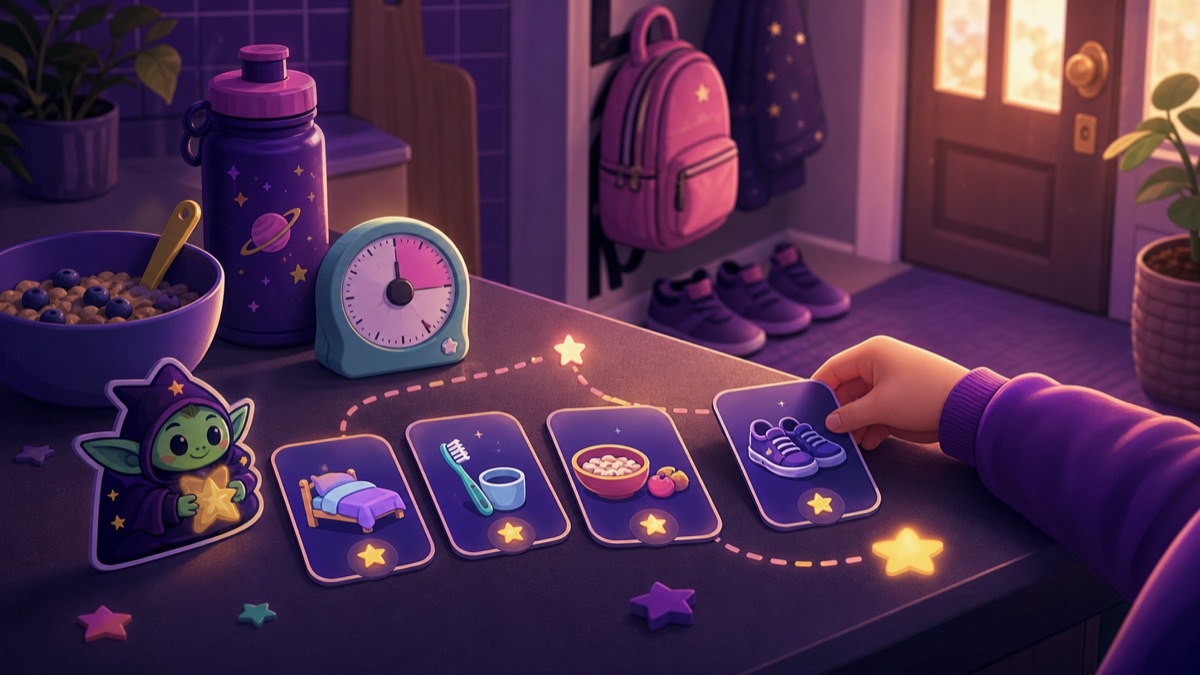
A morning routine for kids can fall apart fast because the morning asks for too many switches in a short amount of time.
Wake up. Leave the warm bed. Handle clothes. Eat something. Find the backpack. Put on shoes. Stop playing. Walk out the door.
For a child with ADHD, autism, AuDHD traits, sensory overwhelm, or a brain that struggles with transitions, that is a lot of invisible work before school has even started.
A useful morning routine shows the next step clearly enough that the adult does not have to hold the whole routine in their voice.
Pick the real stuck point
Start with the part of the morning that causes the most trouble.
For many families, it is one of these:
- getting out of bed
- choosing clothes
- eating breakfast
- packing the backpack
- putting on shoes
- leaving the house
Do not fix the whole morning at once. Pick one spot where the routine usually jams.
If shoes are the daily fight, build the first version around shoes. If the child freezes after breakfast, build the first version around the move from table to backpack. A useful routine starts where the morning actually breaks.
Make the morning visible
Spoken reminders disappear quickly when a child is tired, rushed, hungry, or already overloaded.
Try putting the morning outside your voice:
- picture cards on the wall
- sticky notes near the door
- a whiteboard with five icons
- a visual timer
- a basket for finished cards
- an app mission for one tiny step
Keep it short. A morning routine for kids works better when it shows the next few steps that usually need adult reminders.
For example:
- Clothes.
- Breakfast.
- Backpack.
- Shoes.
- Door.
If five steps are too many, use three:
- Backpack.
- Shoes.
- Door.
Prepare one thing the night before
Morning routines get easier when one decision has already been removed.
Choose the one decision that creates the most friction:
- clothes
- breakfast option
- backpack
- shoes
- jacket
- water bottle
Put that item where the child will need it. Clothes can go in a small pile. Shoes can go by the door. Backpack can sit on a chair instead of disappearing into another room.
One fewer search, choice, or negotiation can make the next morning easier when everyone is tired.
Use a first step that feels almost too small
"Get ready for school" is too big for many kids.
Try:
- sit up
- touch the backpack
- pick up one shoe
- put one spoon in the bowl
- stand by the door
The first step only needs to create movement. Once the body has started, the next step has a better chance.
If the child says, "I can't," make the step smaller. "Put on shoes" can become "bring shoes to the mat." "Eat breakfast" can become "sit at the table." "Get dressed" can become "choose socks."
Reduce morning talking
More words can make mornings harder, especially when the child is still waking up or already stressed.
Use fewer words and more pointing:
- point to the card
- move the next card closer
- circle the next step
- tap the timer
- hold up two choices
You can say:
"Next card."
"Shoes or backpack first?"
"Timer or no timer?"
"Reset, then door."
Short language lowers the amount the child has to process while their body is trying to move.
Add a reset before the hard transition
Leaving the house is a transition. For some kids, shoes and backpack are manageable, but the switch from home to school is hard.
Try one reset before the door:
- water
- pressure hug
- headphones
- quiet corner
- wall push
- one minute of movement
- choose car music
Put the reset before the predictable crash point. If the child usually melts down after shoes, add the reset between shoes and door. If the child freezes before shoes, add it before shoes.
A reset is part of the route out of the house.
If the morning problem is too much body energy, use one of these calming techniques for hyperactivity before the next card.
Decide what can be skipped
Late mornings need a shorter plan.
Before the next hard morning, decide what can disappear when time is gone:
- cereal instead of cooked breakfast
- shoes by the door instead of in the room
- hair brushed later
- backpack packed the night before
- one adult reminder instead of five
Tell the child what changed:
"Short morning. Clothes, backpack, shoes, door."
The child can still see the route instead of hearing a pile of corrections.
A simple morning routine to try tomorrow
Pick three cards:
School morning
- Backpack.
- Shoes.
- Door.
Put the cards near the last steps of the morning. The door area is often better than the bedroom because it is where the final steps happen.
When one card is done, let the child move it to a finished spot. If the routine gets stuck, point to the next card and shrink the step.
For example:
"Shoes" can become "one shoe on the mat."
"Door" can become "stand by the door."
That is enough for a first version.
Make the next step easier to find
A morning routine for kids works best when it is short, visible, and easy to repair when the day starts badly.
Some mornings will still be messy. If the child can find the next step with less pressure than yesterday, the routine is helping.