2026-06-11
Transition support for kids with ADHD and autism: making the next thing easier
Practical transition support for kids with ADHD, autism, AuDHD traits, sensory overload, executive dysfunction, and anxiety around switching tasks.
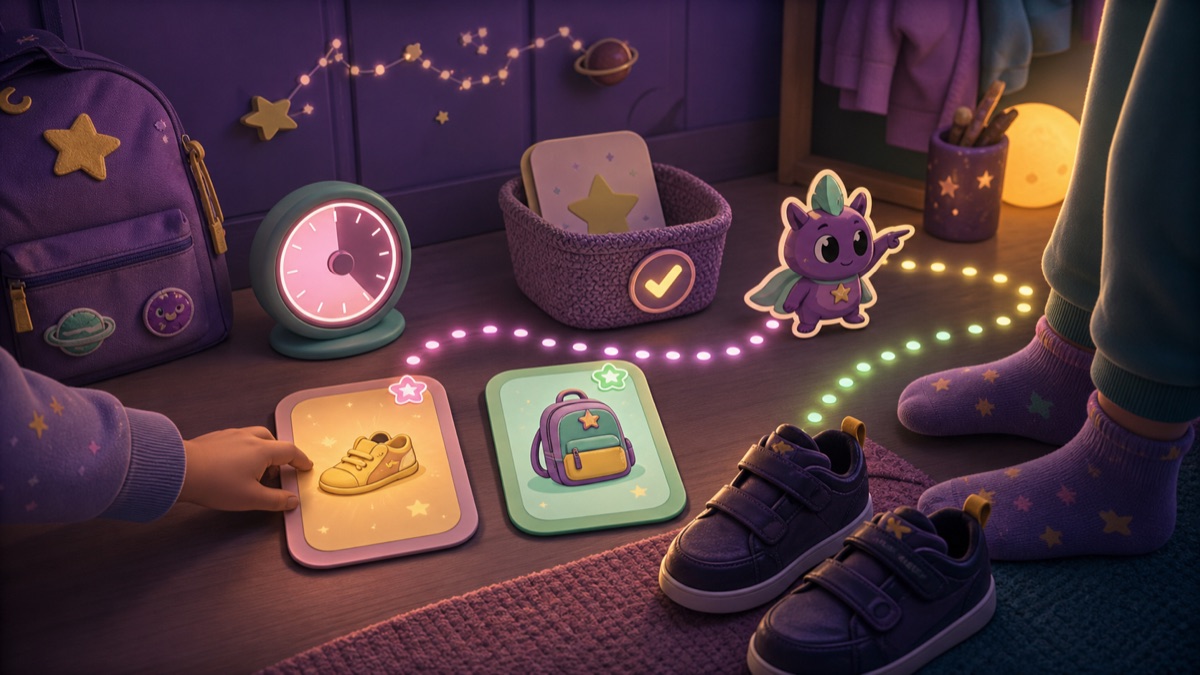
Transition support helps when the switch into the next thing is harder than the task itself.
A child may be able to put on shoes, brush teeth, start homework, or leave the playground on a good day. The same child may freeze, argue, run away, cry, or collapse when the moment arrives too quickly.
For kids with ADHD, autism, AuDHD traits, sensory sensitivity, anxiety, or no diagnosis yet, transitions can ask for several invisible skills at once:
- stopping something interesting
- understanding what comes next
- handling a change in body state
- finding the first step
- coping with time pressure
- managing disappointment
- moving through noise, light, clothing, people, or touch
That is a lot to do while an adult is saying, "Come on, we have to go."
A realistic goal: make the next step easier to find.
Name the transition, not the whole routine
"Get ready" is often too big.
Try naming the exact switch:
- screen to dinner
- pajamas to teeth
- breakfast to backpack
- car to classroom
- playground to shoes
- homework break to first problem
When you name the transition, you can support the actual stuck point.
If the child can do homework once seated, support the move from couch to table. If the child can put on shoes but melts down before leaving, support the move from home to outside.
Look for the moment where the body stops moving.
Give warning without creating a countdown battle
Some kids need warning before a transition. Some kids hear a warning and start bargaining for more time.
Try a warning that gives shape, not a long negotiation:
- "Two minutes, then shoes."
- "One more video, then dinner."
- "When the timer rings, backpack."
- "After this page, bathroom."
- "First jacket, then car."
Keep the warning short and repeatable. If the child argues, return to the same phrase instead of adding a speech.
"Two minutes, then shoes."
"I hear you. Two minutes, then shoes."
"Shoes are next."
The fewer words you add, the less there is to fight with.
Make the next thing visible
Transitions get harder when the child has to hold the plan in working memory.
Put the next step outside your voice:
- one card on the table
- shoes by the door
- backpack on a chair
- a visual timer
- a finished basket
- a sticky note on the bathroom mirror
- an app mission for the first tiny step
For example, "go upstairs and get ready for bed" can become one visible card:
Bedtime switch
- Pajamas.
- Teeth.
- Bed.
If three steps are too many, use one:
- Pajamas.
The next step should be findable when the child is tired, annoyed, or already overloaded.
Use a bridge object
A bridge object gives the child something to carry from one state into the next.
It can be:
- a small toy
- headphones
- a water bottle
- a card
- a keychain
- a hoodie
- a sidekick timer
- one item from the previous activity
The object gives the transition a small bridge between activities.
For example:
"Bring the dinosaur to the table."
"Headphones come with you to the car."
"The card goes from couch to backpack."
Some kids move more easily when their hands have a job.
Shrink the first movement
The first movement matters more than the full instruction.
Instead of:
"Go get ready for school."
Try:
- touch the backpack
- stand by the shoes
- put one foot on the mat
- carry the card to the door
- open the notebook
- sit on the chair
- put the toothbrush in your hand
This is especially useful for task initiation. The child does not need to feel ready for the whole task. They only need a movement small enough to begin.
If the child says, "I can't," shrink again.
"Put shoes on" can become "touch one shoe."
"Start homework" can become "open the notebook."
"Leave the playground" can become "walk to the bench."
Add a reset between activities
Some transitions fail because there is no landing space between one thing and the next.
Add a short reset:
- water
- pressure hug, if the child likes it
- wall push
- one minute of quiet
- headphones
- five deep breaths
- a short walk
- sitting near an adult without questions
The reset should not become a second activity that is hard to leave. Keep it simple and predictable.
Try:
"Reset, then shoes."
"Water, then backpack."
"Wall push, then bathroom."
For some children, the reset is the path into the next task.
When the transition comes with too much movement or a child who cannot settle, this guide to calming techniques for hyperactivity gives concrete body-first options.
Watch for sensory transitions
Some transitions look behavioral but are partly sensory.
Examples:
- warm bed to cold room
- bare feet to socks
- quiet car to loud classroom
- playground light to indoor light
- tablet sound to dinner noise
- wet bath to dry pajamas
- soft clothes to stiff uniform
If the sensory change is the hard part, support that change directly:
- warm clothes before getting out of bed
- socks with fewer seams
- headphones before entering a loud room
- dimmer light before bedtime
- towel ready before bath ends
- a quiet minute after school
You are not spoiling the child by reducing a predictable sensory spike. You are removing one load from an already hard switch.
Decide what happens when the transition fails
Hard transitions will still happen.
Before the next hard one, decide the repair plan:
- pause for one minute
- reduce words
- make the next step smaller
- remove extra people
- offer one choice
- use the reset menu
- try again from a closer starting point
Avoid adding a pile of consequences during the hardest moment. Consequences often create a second transition: from overloaded to ashamed, defensive, or stuck.
Try:
"Pause. One step."
"Shoes came too fast. Touch one shoe."
"We are making this smaller."
The repair plan should help the child return to movement.
A transition plan to try this week
Pick one daily transition that usually jams.
Write it as a tiny route:
Screen to dinner
- Two-minute warning.
- Timer rings.
- Carry cup to table.
- Sit near adult.
Home to school
- Backpack by door.
- Shoes on mat.
- One wall push.
- Door.
Homework break to first problem
- Water.
- Open notebook.
- Write name.
- Stop or continue.
Put the plan where the transition happens. If it fails, make the first movement smaller next time.
How Goblinaut can help
Goblinaut can turn a transition into a small mission.
Instead of asking the child to handle the whole routine, you can create one tiny step: touch the backpack, bring shoes to the mat, open the notebook, sit near the table, or choose the next card.
The sidekick can stay nearby during the first minute. The SOS screen can help when the transition is tangled with noise, frustration, or too many words.
For many families, the useful part is making the next step visible enough that the child can move again.
Further reading
For medical, school, or therapy decisions, use professional advice. These resources are useful starting points: