2026-06-05
Visual routines for ADHD: how to make daily steps visible
How visual routines for ADHD can help kids start daily tasks, move through transitions, and recover when the plan changes.
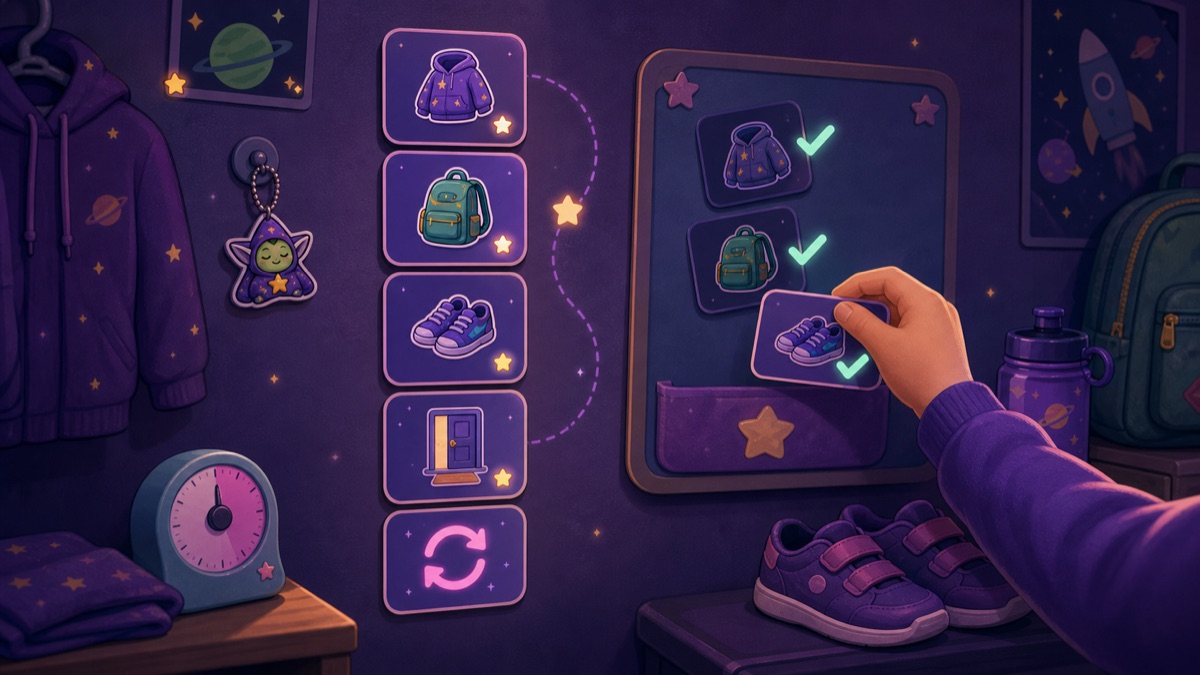
Visual routines for ADHD can make daily life easier because they move the plan out of the air and into something a child can see.
That sounds simple. It matters because spoken instructions disappear quickly. A child may hear "brush teeth, get dressed, pack your backpack" and lose the middle step before their body has started the first one. Add noise, time pressure, uncomfortable clothes, hunger, or a school morning deadline, and the routine can fall apart before anyone understands why.
A visual routine gives the day a shape. It shows what comes next, how much is left, and where the child can begin.
Start with one hard moment
Begin with the part of the day that causes the most friction. For many families, that is:
- getting ready for school
- starting homework
- leaving the house
- bath or shower time
- bedtime
Choose one. A visual routine works best when it solves one real stuck point at a time.
If mornings are hard, build a morning strip. If homework is hard, build a homework strip. If bedtime is hard, build a bedtime strip.
Use pictures before words
Many kids can read perfectly well and still respond better to pictures during stressful moments. Reading takes effort. Decoding a sentence takes effort. A picture of shoes is faster than the word "shoes."
A visual routine can use:
- photos of the child's real objects
- simple drawings
- printed icons
- sticky notes with one symbol
- app mission cards
- a whiteboard with tiny sketches
The picture only needs to be clear enough for the child. It can be plain. It can be imperfect. A useful card beats a beautiful card that never gets used.
Keep the routine short
Long visual routines can become another wall of demands. Start with three to five steps.
For a school morning:
- Clothes.
- Breakfast.
- Backpack.
- Shoes.
- Door.
For homework:
- Snack.
- Open notebook.
- Do one question.
- Check in.
- Stop or continue.
For bedtime:
- Bathroom.
- Pajamas.
- Book.
- Light down.
- Bed.
Aim for a routine the child can scan quickly. If the child gets lost halfway through the routine, shrink it.
Make the first step almost too easy
The first card should create movement. It should be small enough that the child can start while their brain is still catching up.
"Clean your room" is too large for a first card. Try:
- put one shirt in the basket
- choose one toy to move
- stand near the shelf
"Do homework" is too large for a first card. Try:
- open the notebook
- write the date
- circle the first question
Starting is often the hardest part. Once the body is moving, the next step has a better chance.
Show finished steps
Visual routines work better when the child can see progress. Finished steps can move to a done column, flip over, disappear into a small box, or get checked off.
This gives the child useful information:
- "I already did something."
- "There are two steps left."
- "The routine has an ending."
That ending matters. Some kids avoid starting because the task feels endless. A visible finish line makes the routine less blurry.
Add a reset card
Every visual routine should have room for regulation.
A reset card can mean:
- water
- pressure
- quiet
- movement
- breathing
- dim light
- headphones
- a short body-doubling moment
The reset card belongs in the routine before the predictable hard point. If a child usually struggles right after school, put the reset before homework. If bedtime always escalates after bath, put the reset between bath and pajamas.
Regulation is part of the routine. It helps the next step become possible.
For a child with too much energy in the body, the reset card can point to ADHD calming strategies such as wall pushes, chair push-ups, water, or a quiet place.
Use choice carefully
Choice can help. Too much choice can stall everything.
Offer small, contained choices:
- "Shoes first or backpack first?"
- "Blue card or green card?"
- "Timer or no timer?"
- "Quiet reset or movement reset?"
The routine stays stable. The child gets a little control inside it.
Repair the routine when real life interrupts
Visual routines should be easy to change. A missing shoe, late bus, unexpected visitor, or bad night of sleep can shift the whole morning.
When that happens, update the visible plan:
- remove a step
- move one card
- circle the next card
- add a reset
- shorten the routine
You can say: "The plan changed. This card is next." Over time, the child gets practice with a plan that can change and continue.
What to avoid
Some visual routines become harder than the problem they were meant to solve. Watch for these signs:
- too many cards
- tiny text
- unclear icons
- rewards attached to every step
- a routine that only the adult can manage
- a board that stays on the wall while the child struggles somewhere else
The routine should reduce adult prompting. It should make the next step easier to find.
A simple visual routine you can try today
Pick one stuck moment. Choose three cards.
For example:
Leaving the house
- backpack
- shoes
- door
Put the cards where the routine happens. Point to the first card. Let the child move it when it is finished.
That is enough for a first version.
The useful routine is the one your child can use
Visual routines for ADHD work best when they are short, visible, flexible, and easy to repair. They can support autistic kids, AuDHD kids, and any child who needs help with starting, transitions, or organization.
The useful routine helps the next step feel possible.