2026-06-18
Why rewards stop working for kids with ADHD and autism
Why sticker charts, rewards, and consequences can stop helping kids with ADHD, autism, AuDHD traits, and task initiation struggles, plus what to try instead.
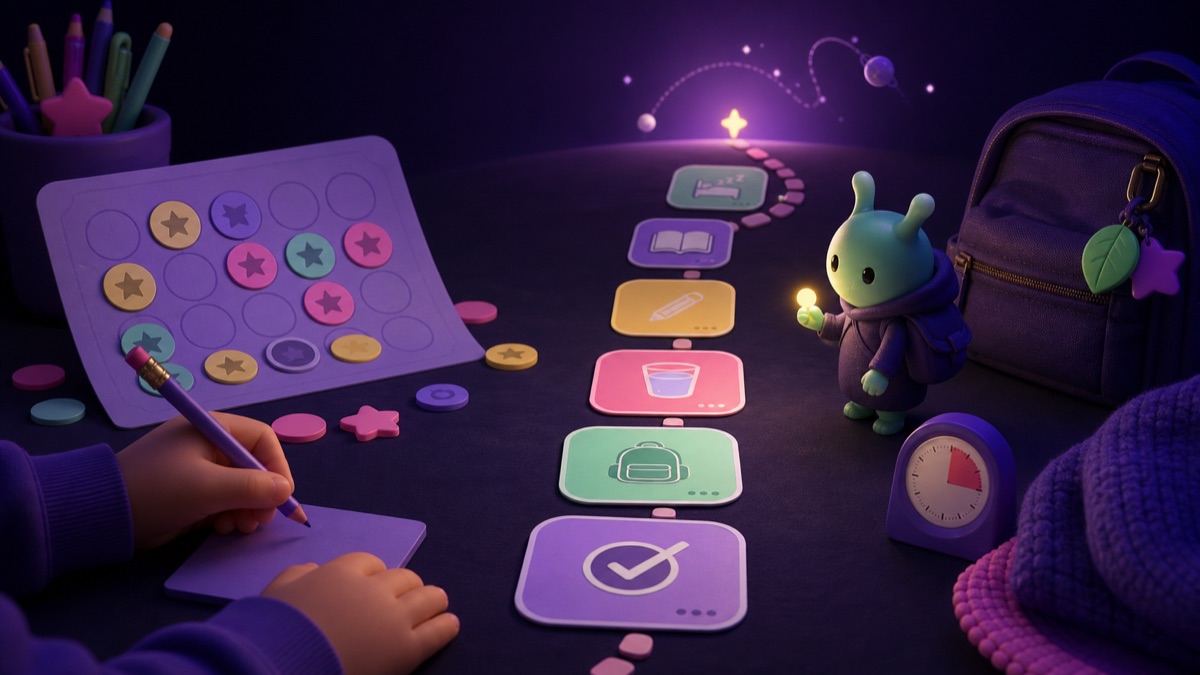
Rewards can help some children with some tasks. A sticker chart, a small prize, or a promise of screen time can make a clear behavior easier to repeat.
The problem starts when adults use rewards for a task the child cannot enter yet.
For many children with ADHD, autism, AuDHD traits, sensory overload, anxiety around tasks, or executive function struggles, the outcome is too far away for the brain to use first. Starting, switching, tolerating the feeling of the task, or staying regulated long enough to take the first step may need support before the reward matters.
When that is the stuck point, a reward after the task can feel very far away.
The reward is too far from the hard moment
Many reward systems depend on delayed motivation:
- finish homework, then screen time
- get dressed all week, then choose a prize
- earn five stickers, then get a treat
- stay calm at school, then do something fun at home
That can work when the child can already see the path from now to later.
For a child who is overloaded, later may not help. The nervous system is dealing with now: the itchy shirt, the loud room, the boring worksheet, the confusing instruction, the pressure in the adult's voice, the feeling that the task is too big.
In that moment, the useful support is usually closer than the reward:
- one visible step
- a body reset
- a smaller ask
- a timer
- a choice between two starts
- an adult nearby without pressure
The reward may still exist. It just cannot do the whole job.
The task is too big
Rewards often fail when the task name hides too many steps.
"Clean your room" can include:
- Notice what is messy.
- Decide where to start.
- Pick up clothes.
- Sort clean from dirty.
- Put toys away.
- Handle trash.
- Ignore interesting objects.
- Keep going after the first boring minute.
That is a lot of planning, sorting, inhibition, and task switching.
If the child cannot begin, offering a reward for the finished room may add pressure without adding a start point. A better first move is to make the first step small enough to touch.
Try:
- put one shirt in the basket
- pick up three blocks
- move trash to the door
- sit on the bed with the basket nearby
- choose: clothes or toys first
The first step should be so small that it almost feels silly. That is often where movement begins.
The reward turns into pressure
Rewards can quietly become another thing to fail.
A child may hear:
- "If you wanted it enough, you would do it."
- "Everyone else can earn it."
- "You lost it again."
- "Now the adult is disappointed."
That feeling can make the task harder to enter next time.
This matters for children who already carry a long history of correction. By the time a parent offers the reward, the child may already expect the system to end with shame, bargaining, or a lost privilege.
If a reward system is creating daily fights, the system is giving you information. It may be asking too much, too late, or in the wrong form.
Some kids need regulation before motivation
A child who is dysregulated may not be reachable through rewards yet.
You might see:
- running away from the task
- shouting
- hiding under furniture
- laughing at the wrong time
- refusing every option
- freezing
- suddenly needing food, water, or a different sock
Those behaviors can look like avoidance. Sometimes they are avoidance. They can also be signs that the child's body has moved into alarm, shutdown, or too much energy.
Motivation works better after the body has a way back.
Try a regulation step before the task:
- push the wall for ten seconds
- drink water
- sit under a blanket for one minute
- crawl like a bear to the next card
- squeeze a pillow
- breathe with a quiet timer
- stand beside the task without doing it yet
Then shrink the task.
What to use instead of bigger rewards
If the reward is not helping, make the task easier to enter.
Make the next step visible
Use a card, sticky note, picture, object, or app mission for the first step.
Instead of saying, "Do your homework," show:
- Open notebook.
- Write name.
- Do one problem.
You can read more about this in the guide to visual routines for ADHD.
Make the first step smaller
The first step should create movement, not prove effort.
"Start homework" can become:
- touch the pencil
- open the notebook
- write the date
- choose the first question
- sit near the table
If the child starts, you can build from there.
Put support inside the task
Some children start better when another person is nearby.
That support does not have to be a lecture. It can be quiet presence:
- sitting nearby while the child opens the notebook
- folding laundry in the same room
- doing your own work at the table
- starting a timer and staying close
- turning the task into a small mission together
For many children, the first useful reward is the feeling that the task is survivable.
Use immediate feedback
Delayed rewards are hard for many kids. Immediate feedback can work better:
- move the card to "done"
- hear a small sound
- check off one tiny step
- see a progress bar move
- let the sidekick react
- take a short reset after one step
The child should feel progress while the task is happening.
When rewards can still help
Rewards can still help when:
- the task is already clear
- the child can start without panic
- the reward is close enough to matter
- the goal is realistic
- the child helped choose it
- losing the reward does not become the main event
Praise can also help when it names the action clearly:
"You opened the notebook even though starting was hard."
"You moved one card. That counts."
"You came back after the reset."
That kind of feedback helps a child notice what worked.
A quick reset for a stuck reward system
If rewards have become a daily fight, try this for one task:
- Pause the chart for a week.
- Pick one task that causes the most friction.
- Write the smallest first step.
- Put that step where the child can see it.
- Add one regulation option before the step.
- Give feedback as soon as the first step happens.
For example:
Task: homework.
First step: open the notebook.
Regulation option: wall push or water.
Feedback: move one card to done.
The goal is to help the child enter the task with less friction. After that, rewards can become a bonus instead of the engine.
How Goblinaut thinks about rewards
Goblinaut is built around small missions, visible steps, sidekick presence, and regulation tools.
That matters because many children do not need a bigger prize. They need the first step to stop feeling impossible.
The app can turn one stuck task into a tiny mission, offer an SOS option when everything is too much, and give the child immediate feedback as they move. Parents can still use rewards if rewards help their child, but the task itself gets more support.